Monday, October 31, 2011

Demise of the Banana Tree Forest

Several years ago my darling daughter gave me a new banana tree that was reported to do well in this climate.  We had grown banana trees for years and every fall we put them in the crawl space.  They did well in pots but had to be protected from the frost.

 The new variety does not have to be put up in the winter.  This is what it looks like now:


Since we are always experimenting in the Experimental Garden the first few years we cut the plants off at the ground, before the first frost, mulched them, and they came back, year after year.  Last year we waited until the first frost killed the plants off, then we cut them down.  And they came back anyway.


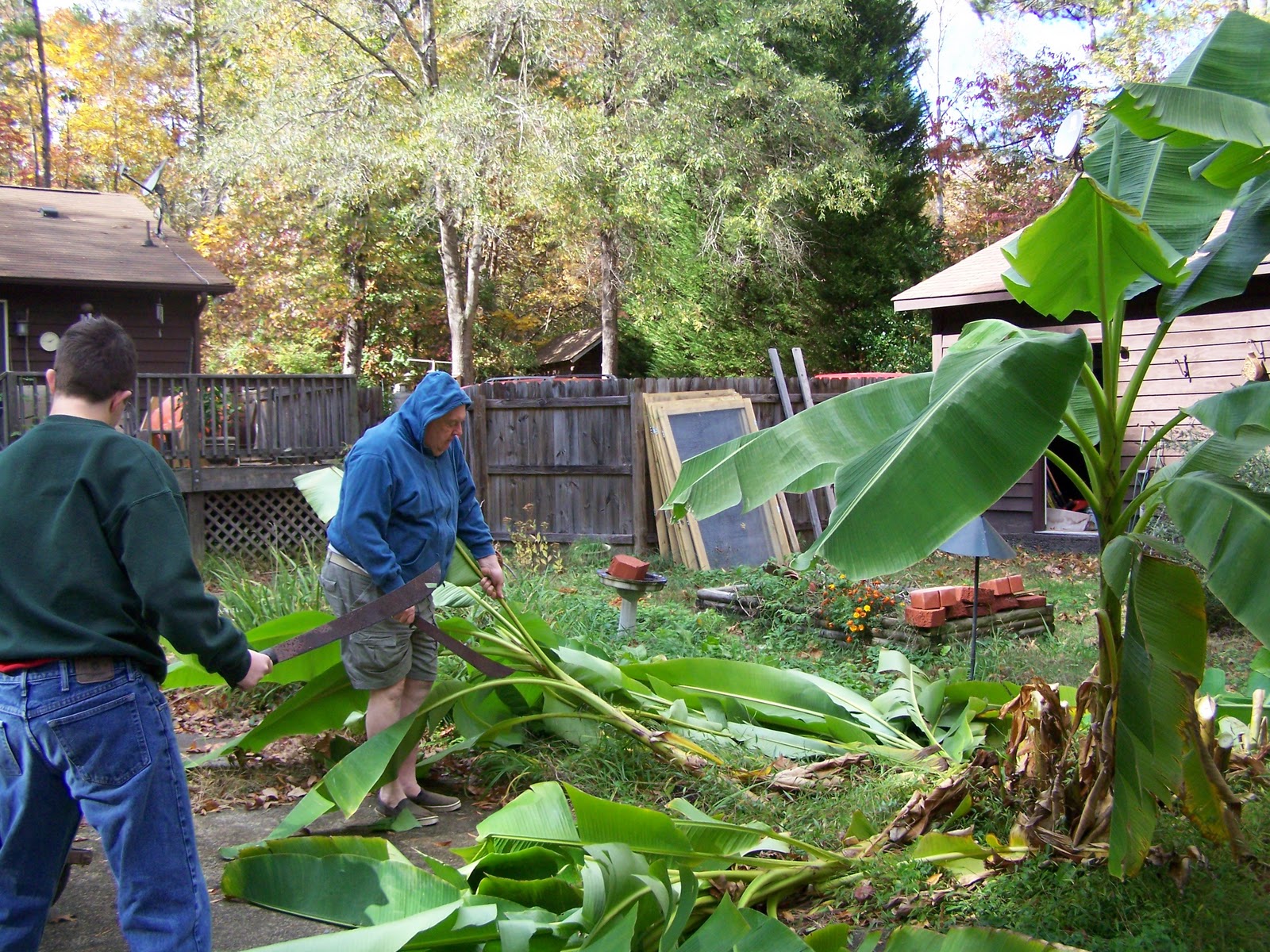
Here is the team cutting them down on Oct. 29th before the first frost.


One more experiment.  This year we are leaving two trunks after removing the leaves.  The hope is the trunks will sprout leaves next spring and not have to start from the ground up.  Stay tuned.


I miss them already.

Wednesday, October 19, 2011

A different sort of garden

While wandering through Alamance County we happened upon a garden of sculpture.  Beyond the Frame , sculptures of J. Seward Johnson, Jr.  People become part of the art.  Who is real and who is not?


Thursday, September 15, 2011

September Bloom Day

Not a lot of blooms to show after a long hot dry summer.
Garlic chives always provide a nice white bloom late in the summer.  It can be seen from quite a distance.


This is a little wild vine, probably in the morning glory family since it blooms in the morning.  It has tiny flowers and the hummingbirds love them.


 Sedum is always beautiful this time of year.


The moon flower has a visitor every evening.  He works and works on cleaning the stamin.


This picture was taken a couple of weeks ago.  No sign of catepillar's on the parsley today.  We plant lots of parsley for them to eat.


Mums help with the color.  Thanks to the box store.


Still have butterfly bush blooming.


Time to harvest some seeds from the butterfly weed and


and parsley.

Thursday, September 8, 2011

Inspection Day

Finally the temp is reasonable and no storms so we went to our friend Aggie's to look at her bee hive.
There are two hive bodies and one super.  The super is where you hope the honey bees will store their honey.  The hive bodies is where you hope they will raise their brood.


Opening the super we could spot honey right away.  Notice the frames are smaller than the ones you will see later from the hive body.  All the white cells are full of honey and capped.


The girls have been busy.  Aggie has beautiful flower and veggie gardens and these bees made good use of them.


As we lifted the frames the honey would drip out and the bees quickly converged to eat it. 

 Below the super is the top hive body and you can see the bees were filling all the space.  The big mound on top is where they built comb and put honey.  Bees will fill whatever space is available. 

Now we know there is enough honey to harvest.


We left Aggie's and went home to look at our two hives.  Last spring we lost our bees and bought two nucs to replace them.  The green hive was refilled with a small nuc.  We opened it first to check the top hive body (we do not have supers on these hives because the bees need to build out the frames and raise brood.)

The frames had bees on them but they have not build out the comb and they are empty.


So next we checked in the bottom hive body.  The brown colored capped comb is where the brood resides.  These are larvae cells that have been capped with a wax cover.  The pattern of tight, compact cells is a healthy sign.  They are slightly convex and there is an occasional cell that is not yet capped.  All this is a sign of a strong queen.


Next we opened the yellow hive which has a larger, stronger colony. The top hive body had honey.  The capped honey is white and the cap is flat.  Seems that these girls have had better luck with the honey.  We did not go into the bottom hive body but it looked like it had brood.


Next, we plan to extract honey from Aggie's hive.
Stay tuned.

Wednesday, August 24, 2011

early morning beauty

It is worth getting up early to see the morning glories and last nights moon flowers both in bloom.


Monday, August 15, 2011

Experimental Garden August Bloom Report

July and August have been hot and dry.  My apologies to Texas because they are much hotter and dryer and I should not even try to compare.
That said, there is not a lot of color in the Experimental Garden.  We only water plants in pots, and use the rain barrels for that.  So much of the gardens have gone to the weeds.

 This came from seeds from my daughter's garden.  Maybe she can supply the name.


Lantana is blooming again.
 A few zinnas left for picking.


Begonia's in pots are still blooming.


Black-eyed Susans are almost finished.


Herbs in pots will last until the first freeze and then come back next year.


 Roses have gone to the June beetles.

You can always count on wild golden rod to bloom in August.


There are a few of the tomatoes that the squirrels did not get once we got the cage secure.


Marigolds volunteered in the tomato cage.


It is the time of year when we get to see the orb weavers spin their beautiful webs.  This one has become a fixture in the front yard and is eating well. 


Could not resist sharing this picture of a humming bird perched on a stick.
 

Happy August blooms.

Friday, July 15, 2011

Experimental Garden July Bloom Report

Ahhh July, in NC, 90/90, temp and humidity and the three H's, hot, humid, hazy.

My sister the Master Gardener introduced us to Moon Flowers
(Ipomoea alba)
years ago.  One evening we discovered something very fast feasting on the blooms.  After much observation we found a moth.  Our gardener in training decided to take a picture but I was sure this was not possible.  Below is the picture he took.

Our  entomologist identified it as a pink hawk spotted moth.  We were then able to register it as being found in our county.


That is not the only thing exciting about this flower.  It blooms at night and you can watch the bud open.  I cannot do time lapse so here is the next best thing.  These pictures were taken when it was trying to rain.

 Bud on the left is from yesterday, on the right is getting ready to open.


A few minutes later.


A few minutes later, the excitement is building...


As the storm built I had to take a picture of another one in full bloom.


Such a beautiful flower, fragrant, but the vine looks just like our wild morning glories.


We also learned that the pink hawk spotted moth lays it eggs in sweet potato vine and the caterpillars grow up there, so we always plant the vine near the moon flowers.


After all that excitement, we move on the the annuals that are blooming now.

Volunteer black eyed susans.


Hybiscus.


zinnias


And my favorite banana trees.


OK, everything here in the garden is an experiment.  But the seed package said bell peppers.  Am I wrong, or are these some other kind of pepper?

Cukes on the fence.